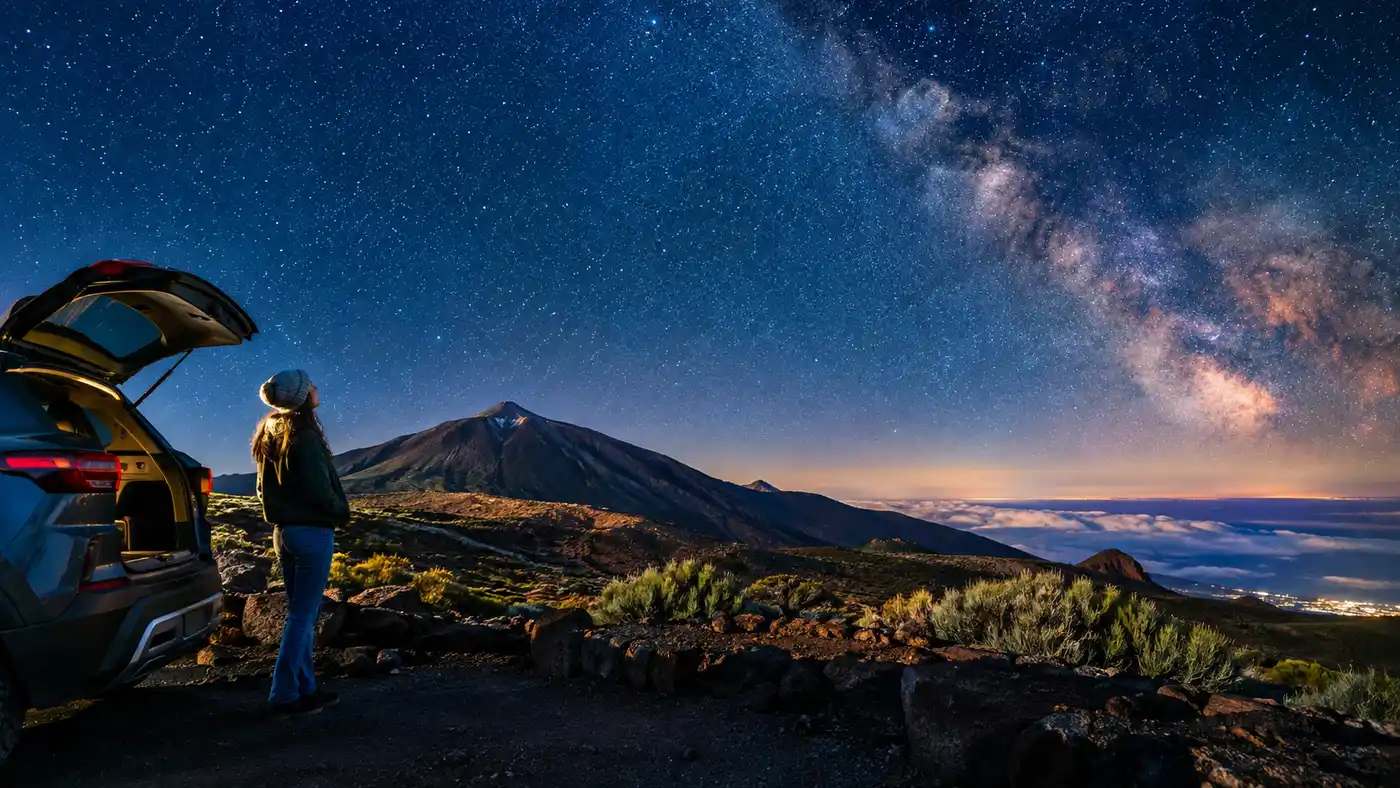
Self-Drive Stargazing in Tenerife: How to Stargaze on Your Own
Most tourists visit Mount Teide crammed into a 50-seater bus, listening to a canned commentary through cheap headphones before getting shuffled onto a concrete platform for twenty minutes. You do not have to do that. Setting out for stargazing tenerife on your own gives you total control over when you arrive, which pull-off you claim, and how long you linger under the Milky Way. It is cheaper, quiet, and surprisingly simple if you have a rental car and warm clothes.
The road into the caldera climbs through thick pine forests and punches right through the sea of clouds into dry, thin air above 2,000 meters. Up there, the humidity drops to single digits. Light pollution from coastal resorts like Playa de las Americas gets blocked by the mountain walls below. You are left alone with silence and an astonishing blanket of stars.
Book your stargazing tenerife experience:
Why Choose a Stargazing Tenerife Self Drive Trip?
Freedom is the obvious reason. Group tours operate on rigid schedules, meaning if cloud cover sits unusually high at their chosen spot, they rarely have the time to drive ten kilometers down the TF-21 to find a clearer clearing. When you do a stargazing tenerife self drive evening, you chase the clear patches yourself. You can pull over at an empty overlook, turn off the ignition, and listen to the wind whistle through volcanic pumice.
Cost plays a big part too. Commercial tours run anywhere from €45 to €140 per person depending on whether wine and cheap jackets get handed out. A small rental car for the entire day often costs around €28, plus maybe €15 in petrol. If there are two or three of you, doing it yourself is a fraction of the price. You also eat dinner on your own schedule instead of waiting around in a crowded tourist buffet in Vilaflor.
There is also the solitude. Standing alone at Roques de Garcia at midnight feels like being on Mars. Tours tend to cluster in three specific parking lots with green laser pointers waving across the sky. By driving yourself, you can slip into tucked-away lay-bys where nobody else stops. Check our guide to the best stargazing spots in Tenerife to see which spots get crowded and which ones stay deserted.
Planning Your Route: A Stargazing Tenerife on Your Own Map Guide
Teide National Park has four main access roads, and your ascent depends entirely on where you stay on the island. The southern approach via the TF-21 from Vilaflor is the most common. It is smooth, wide, and takes about 50 minutes from Los Cristianos. The northern approach from La Orotava (also TF-21) is steeper, winding through banana plantations and dense laurel woods before climbing above the fog bank.
Having a mental stargazing tenerife on your own map before the sun sets saves you from fumbling with dead phone service on dark hairpin turns. Mobile signal vanishes in large pockets of the caldera floor. Download your offline maps in Google Maps or Maps.me while you are still sitting on hotel Wi-Fi.
Note: Gas stations do not exist inside Teide National Park. Fill your tank in Vilaflor, Chio, or La Esperanza before heading up the mountain, because running out of fuel at 2,200 meters at 1:00 AM means an expensive tow truck.
Here is how the primary viewpoints along the caldera compare for an independent night drive:
| Location | Elevation | Access Road | Parking Space | Wind Exposure |
|---|---|---|---|---|
| Mirador de Chipeque | 1,830 m | TF-24 | About 15 cars | High |
| Llano de Ucanca | 2,050 m | TF-21 | Multiple roadside bays | Moderate |
| Roques de García | 2,150 m | TF-21 | Large paved lot | Low to Moderate |
| Mirador Minas de San José | 2,240 m | TF-21 | Two medium gravel lots | High |
| Mirador del Tabonal Negro | 2,310 m | TF-21 | Roughly 10 cars | High |
Minas de San Jose feels entirely otherworldly. The ground is pale, powdery pumice stone that catches the ambient starlight. It looks like a lunar desert. It gets cold fast though, because the wide basin traps chilly sinking air once the sun disappears behind the rim.
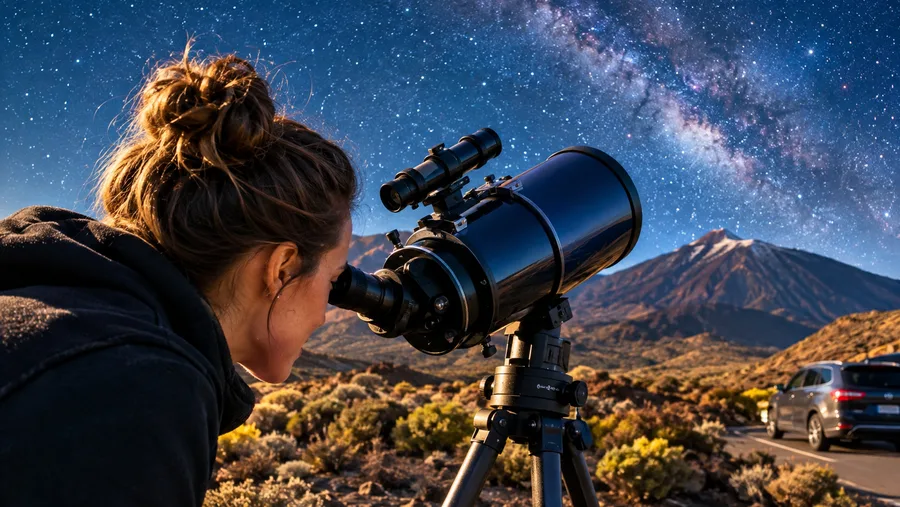
Gear to Pack: Stargazing Tenerife or Binoculars?
People often ask whether they need heavy optical equipment or if casual eyes work fine. Honestly, the naked eye alone reveals an absurd amount of detail on moonless nights. You will clearly see the Great Rift dividing the summer Milky Way, the hazy smudge of the Andromeda Galaxy, and constant satellite glints drifting overhead.
When considering stargazing tenerife or binoculars, simple binoculars win hands down over dragging a telescope in your luggage. A standard pair of 7x50 or 10x50 marine or birdwatching binoculars gathers enough light to resolve star clusters, split double stars, and reveal nebulae without requiring tripods or alignment routines. Telescopes require calibration, battery packs, and careful transport. Unless you are an experienced amateur astronomer willing to pay oversized baggage fees, leave the scope at home and pack decent binoculars instead.
- Red LED headlamp: white phone screens and flashlights ruin your night-adjusted vision for twenty minutes every time you turn them on.
- Thermal base layers: temperatures at 2,200 meters easily drop to 2 or 3 degrees Celsius, even when the coast was 26 degrees at lunchtime.
- Windbreaker shell: the plateau frequently gets hit by gusty winds that strip body heat fast.
- Thermos with hot tea: standing motionless looking up makes you cold much quicker than hiking.
Pro tip: Stick a small piece of red sweet-wrapper plastic over your phone flashlight with a rubber band if you do not own a red headlamp. It preserves your night vision perfectly.
Book your stargazing tenerife experience:
Capturing the Sky: Stargazing Cameras Tenerife and Night Photography
Taking images of the stars requires manual controls. Your smartphone might have a night mode, but results usually look like grainy watercolor unless mounted firmly on a tripod. If you pack dedicated stargazing cameras tenerife journeys become ten times more rewarding. Any mirrorless or DSLR camera with a wide lens (14mm to 24mm) and an aperture of f/2.8 or wider will produce sharp images of the core.
A stable tripod is non-negotiable. Mountain breezes will blur any exposure longer than three seconds if your legs are flimsy. Set your ISO to 3200, aperture wide open, and shutter speed between 15 and 20 seconds. Use manual focus, zoom in on a bright star on your rear LCD screen, and tweak the focus ring until that point of light is pin-sharp. Take a test shot, adjust your histogram, and let the sensor soak up the light.
Many travelers wonder about a stargazing in tenerife site to get photos taken on trip without buying gear. Some local photographers offer private night portraits around the Roques de Garcia rock formations, where they illuminate you with low-level LED lighting against the starry backdrop. If you drive yourself, you might stumble into hobbyist astrophotographers doing this, but do not rely on finding someone out there. If you want guaranteed photos of yourself under the cosmos without buying expensive lenses, booking a dedicated portrait guide ahead of time is your best bet.
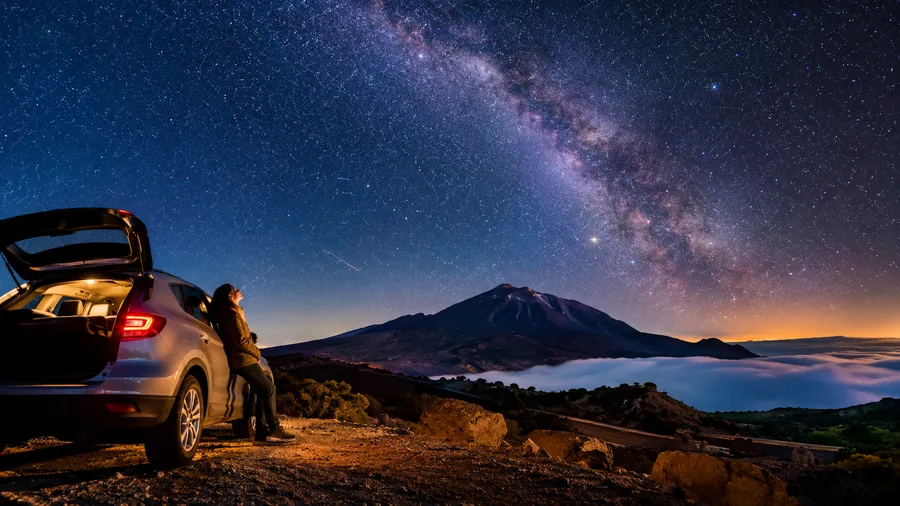
Timing and Conditions for Stargazing Tenerife on Your Own
You cannot just drive up any random night and expect a sparkling show. The moon is your biggest enemy. A full moon drowns out eighty percent of faint stars, turning the night sky into a dull blue sheet. You want to visit within three or four days on either side of the new moon. Review our seasonal breakdown on the best time to stargaze in Tenerife for exact moon schedules and summer versus winter visibility charts.
Check the calima forecast before heading out. Calima is an atmospheric condition where easterly winds blow fine Saharan dust across the Canary Islands. While the air temperature stays warm, the dust creates an orange haze that obscures deep-sky objects and turns stars into blurry dots. You can easily check the Spanish meteorological agency (AEMET) web cameras located at the Izaña atmospheric observatory to verify that the mountain summit is crystal clear before you leave your coastal hotel.
Plan your evening around sunset. Driving the twisting mountain highways while there is still daylight helps you memorize the curves and spot deep gravel edges. Arrive an hour before dusk, watch the sun sink below a carpet of fluffy white clouds, and then let your eyes adjust as darkness settles over the lava fields.
- Arrival window: get to your chosen viewpoint 45 minutes before sunset to claim parking and unpack layers.
- Eye adjustment time: avoid looking at vehicle headlights or bright phone screens for at least 25 minutes for maximum sensitivity.
- Descent timing: drive down cautiously around midnight or 1:00 AM, watching for stray rabbits and rockfalls on the tarmac.
Frequently Asked Questions about stargazing tenerife on your own
Is it safe to drive up Mount Teide at night?
Yes, roads are paved, well maintained, and marked with reflective cat-eyes. Drive slowly, watch for rocks that tumbled onto corners, and use low beams if fog sits in the forest zone below the national park entrance.
Do I need a special permit to stargaze in Teide National Park at night?
No permit is required to drive the public roads or stand at the roadside miradors after dark. Permits are only necessary if you intend to hike the summit trail to Teide's peak between 9:00 AM and 5:00 PM.
Can I sleep in my rental car in the park?
Sleeping or camping in vehicles inside Teide National Park is officially prohibited by environmental regulations to protect the delicate flora. Rangers do patrol the major viewpoints and will knock on windows asking you to move along if you are asleep.
What should I do if the weather is cloudy down at my hotel?
Go anyway. The resort towns often sit under a local cloud phenomenon called the sea of clouds. Mount Teide rises far above this layer, so while it may be drizzling in Puerto de la Cruz, the sky at 2,000 meters is usually dry and completely cloudless.
Quick Reference
- Ideal elevation: 2,000 to 2,300 meters above sea level
- Best phase: 3 days before or after new moon
- Drive time from south coast: 45 to 60 minutes
- Night temperatures: 0 to 8 degrees Celsius year-round
- Car permit required: none for public viewpoints
Book your stargazing tenerife experience:
The Bottom Line
Skipping the organized bus tour and tackling the mountain under your own steam gives you a genuine adventure. There is something grounding about standing in the deep, silent chill of the volcanic caldera with your head tilted back, watching shooting stars streak across the constellations without someone rushing you back onto a coach. Put warm socks in your trunk, pack a hot thermos, rent a modest car, and steer toward the high altitude. It will end up being the best evening of your Canary Islands trip.
Read more about stargazing tenerife.